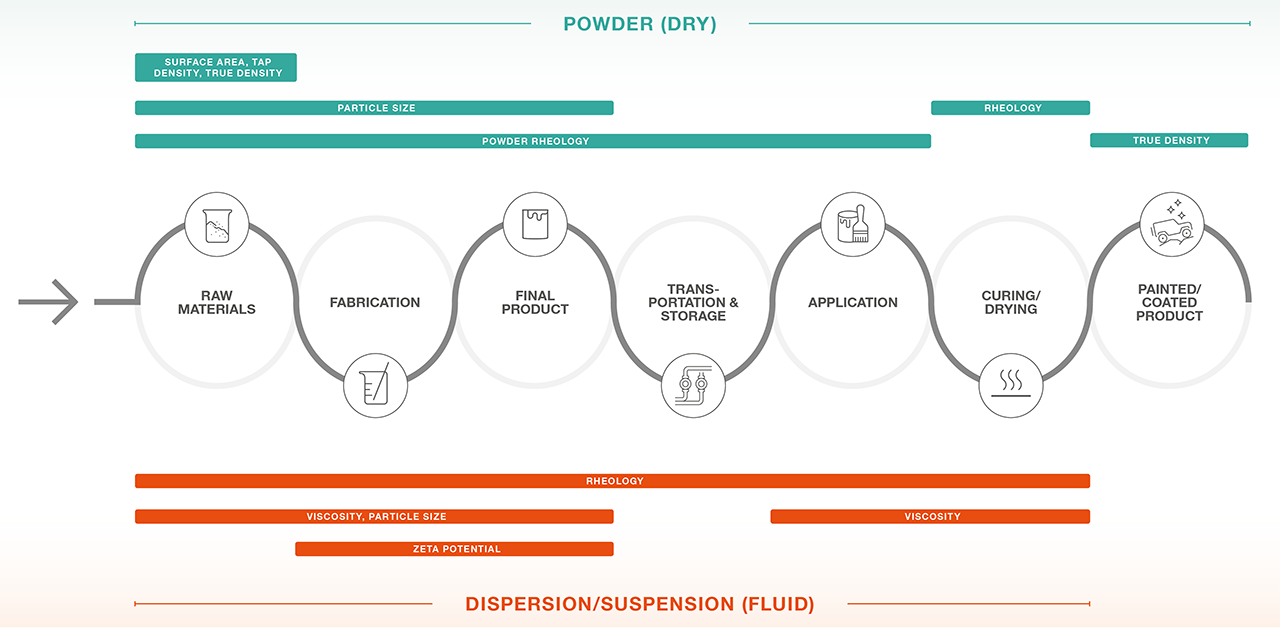
| DISPERSION/SUSPENSION - LIQUID |
| The wood coating is too thin or too thick for the application. |
Determine the viscosity of the coating by performing quick quality control checks at a constant
speed to adapt the consistency. |
The wood coating is neither running off nor leaves uneven ridges on the surface. |
|
| The wood coating is too thin or too thick for the application. |
Determine the viscosity at different shear rates to gain insight into the viscosity of the
coating at rest and during application. |
Use the results to adjust the flow behavior of the wood coating so it is ideal at each stage of
its usage. |
|
| The paint gets stuck while pumping or during application. |
Analyze the yield point of the paint with a rheometer or a viscometer and lower the yield point
so that less force is needed to initiate sample flow. |
Zero downtime of your production plant thanks to a smooth and efficient transportation process
during paint production |
|
| The wall paint produces an inadequate layer thickness or shows sagging after application. |
Analyze the structural decomposition and recovery of the inner structure of the paint to adjust
the formulation. |
Your wall paint has a sufficiently high wet layer thickness and shows no sagging. |
|
| The automotive paint is too thick for spraying and produces small visible droplets that lead to
a bumpy finish. |
Analyze the viscosity of the paint at high shear rates (1,000 s-1 to 10,000
s-1) and adjust the ingredients. |
You can be sure that your product has just the right viscosity for high-shear applications, e.g.
spraying, brushing, and has a smooth finish. |
|
| Pigments and fillers in the architectural paint settle during (short term) storage. |
Analyze the viscosity at low shear rates (<1 s-1) and adjust the formula. |
Use the results to change the formulation and prevent premature sedimentation of the paint. The
higher the viscosity in the low-shear range, the better the stability. |
|
| The paint shows phase separation or sedimentation after a certain time at rest (long term). |
Check the storage stability with a frequency sweep and adjust your formulation. |
Long storage stability of your paint is guaranteed. |
|
| The paint is too thin for the application at 50 °C. |
Determine and adjust the viscosity exactly at the defined temperature. |
The paint has the ideal formulation for the application conditions. |
|
| The hardening of the two-component epoxy coating already occurs during application. |
Analyze the viscosity to find out when it is doubled compared to its state at the beginning of
the reaction. With this knowledge you can adjust the formula of the epoxy coating. |
Your epoxy coating hardens at the right time after the application period. |
|
| The paint does not dry after application in environments with high humidity. |
Adjust the humidity and temperature of the measurement environment during the rheological
characterization of your paint. |
Your paint dries under predefined temperature and humidity conditions. |
|
| The UV-sensitive coating did not cure as expected and the surface shows scratches and bumps.
|
Simulate crosslinking reactions with different intensities of UV light while measuring the
rheological properties. |
A coating that cures within seconds under UV light and perfectly covers and protects the coated
material |
|
| The film of a wood coating is too brittle or too soft after curing. |
Determine the DMA behavior of the film and adapt the formulation. |
Sufficient elasticity of the film and a good coating finish. |
|
| The paint does not achieve the desired final appearance (paint sheen). |
Determine and adjust the pigment particle size. |
A flawless product that shows the desired matt or glossy finish and is bought again by the
satisfied end customer |
|
| The paint does not show the desired color intensity. |
Measure and adjust the pigment particle size as color intensity increases as particle size
decreases. |
Your paint has just the right color intensity and the user is happy with the result after
application. |
|
| The material shows inconsistent coating behavior. |
Determine the particle size of the paint or coating dispersion to identify and prevent particle
aggregation prior to the coating process. |
Uniform coating behavior |
|
| The dispersion shows an unwanted tendency to aggregation. |
Determine the zeta potential of the particles in your dispersion with Litesizer to improve your
formulation and stabilize your production processes. |
Speed up the production process and avoid possible drop-outs of precious batches due to early
recognition of zeta potential issues. |
|
| POWDER - DRY |
| Powder raw materials cannot be pumped. |
Simulate the pumpability of solid raw materials using a powder cell. |
Use the results to avoid issues during transport and storage of powdery materials. |
|
| The powder coating either doesn't cure nicely or cannot be transported pneumatically. |
Determine fluidization and curing behavior and correlate the influence of flow aids on
fluidization as well as the curing process. |
Increased customer satisfaction with powders that can be easily applied and show good curing
behavior |
|
| The powder coating does not appear even. |
Analyze the particle size distribution with a particle size analyzer and optimize it to achieve
the desired outer appearance of the powder coating. |
The powder coating shows high durability and meets the visual requirements. |
|