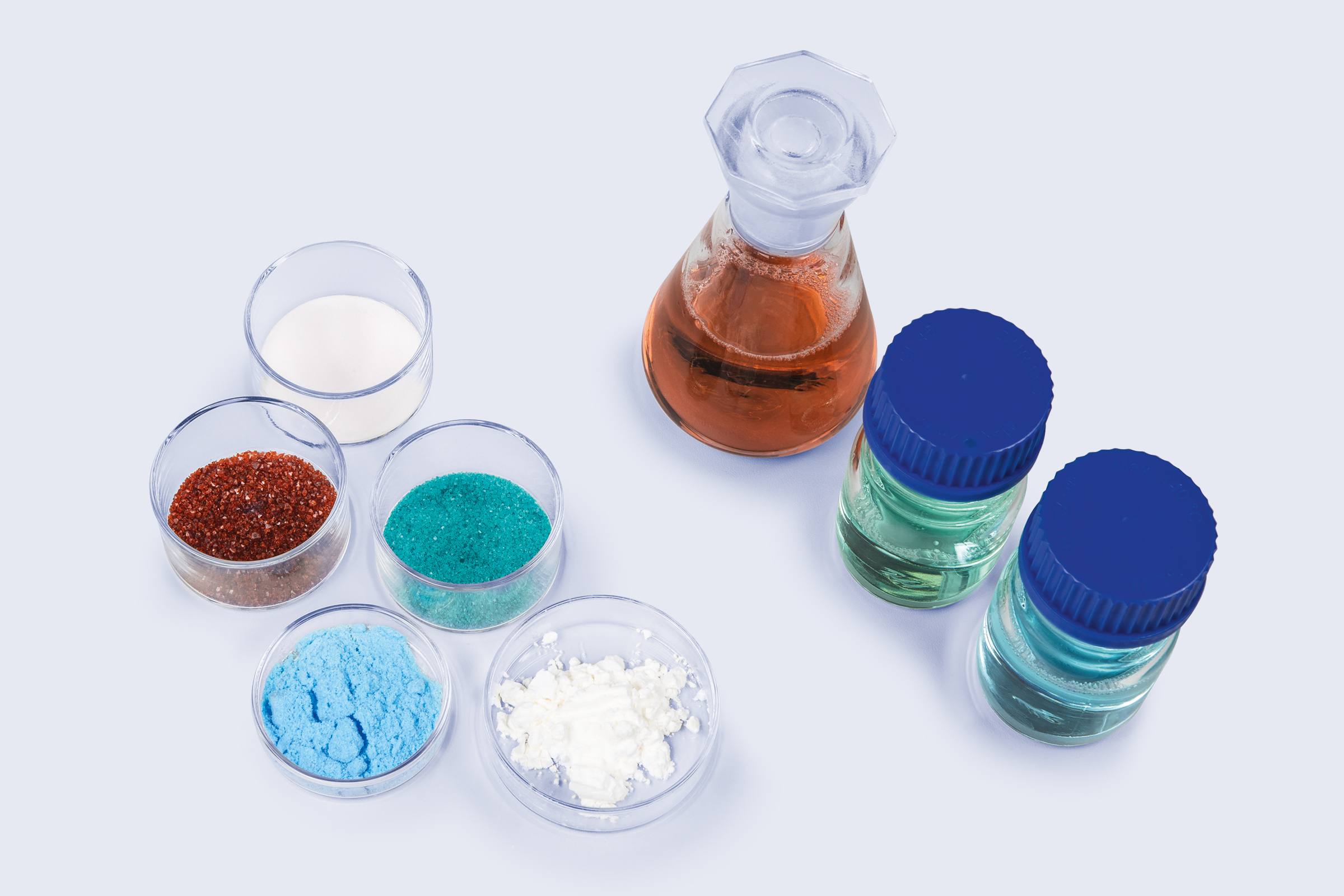
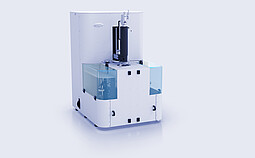

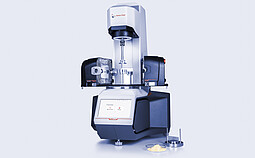
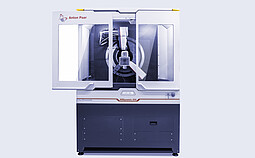

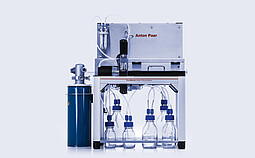








Particle properties determine performance, stability, processability, and overall product quality. Key characteristics such as size, shape, zeta potential, surface area, porosity, density, powder behavior, and structure provide essential insights into material behavior, which enables better control of processes and optimization of end-use performance.
Anton Paar offers a range of analytical solutions for particle testing, tailored to your specific materials and application requirements.

Get in touch

Find the right particle testing method

If you already know the measurement principle you need, navigate directly to the relevant solution. Particle size analysis is performed using dynamic light scattering (DLS) or laser diffraction, with dynamic image analysis (DIA) used to evaluate particle shape and size. Surface area and pore structure are determined by gas sorption or porosimetry; density is determined by gas pycnometry; powder rheology characterizes bulk behavior; and XRD or SAXS provides structural analysis.

Measure the properties that define performance

Particles determine how materials behave at the microscopic level, with size, surface characteristics, and interaction forces influencing everything from stability, reactivity, and optical properties to bioavailability and long-term performance. Measuring these parameters provides quantitative insight into dispersion quality, aggregation behavior, and functional performance.

Define particle size and size distribution

Particle size describes the dimensions of individual particles, while size distribution shows how these sizes are distributed within a sample. Both are typically measured using techniques such as dynamic light scattering (DLS), laser diffraction, or dynamic image analysis, and they influence dissolution rate, reactivity, stability, and flow and packing behavior. Controlling size distribution ensures batch consistency and predictable performance, supporting decisions in process optimization, formulation design, and quality control.

Understand surface charge and interparticle forces

Surface charge, commonly expressed as zeta potential, is measured using electrophoretic light scattering as well as streaming potential or streaming current methods. It defines particle attraction or repulsion and is reflected in dispersion stability, agglomeration, and shelf life. Surface charge informs formulation stability, additive selection, and process conditions.

Evaluate stability and aggregation behavior

Stability and aggregation behavior describe how particles interact over time and indicate whether a system remains dispersed or forms agglomerates. Changes in particle size and interaction forces are tracked using DLS, zeta potential measurements, and techniques such as Turbiscan or transmittance monitoring – informing formulation design, storage conditions, and additive selection for consistent product quality and long-term reliability.

Characterize surface area and reactivity

Surface area refers to the total accessible area of particles and is closely linked to reactivity and interaction potential. It is typically measured using gas adsorption techniques based on physisorption (e.g., BET) and, in specific cases, chemisorption for active surface sites, as well as porosimetry for pore contributions. Higher surface area increases dissolution rate, catalytic activity, and adsorption capacity.

Analyze particle shape and morphology

Particle shape and morphology influence flowability, packing, and mechanical behavior, as well as dispersion and processability. These effects arise from geometric features such as form, aspect ratio, and surface roughness, which are evaluated using dynamic image analysis (DIA). Morphology informs formulation design, powder handling, and process optimization.

Analyze porosity and pore size distribution

Pore structure governs diffusion, adsorption, and permeability in materials. Porosity and pore size distribution describe the volume, size, and connectivity of these pores. These characteristics are analyzed using gas adsorption, mercury intrusion porosimetry, or mercury-free approaches such as eGaIn, and support catalyst performance, filtration efficiency, and quality control.

Determine crystal structure and phase composition

Crystal structure and phase composition identify how atoms are arranged and which crystalline phases are present in a material. They are typically determined using XRD, with SAXS providing additional insight into nanoscale structural features. Structure and phase composition influence mechanical properties, stability, dissolution, and overall performance, supporting decisions in material selection, process control, formulation development, and quality assurance.

Measure density and structural compactness

Density and structural compactness describe how much material is contained within a given volume and how efficiently particles or solids pack. Measured using gas pycnometry for true density and tapped density for packing behavior, these parameters are reflected in formulation consistency, powder handling, porosity, and dosage or fill accuracy – informing raw material selection, process optimization, packaging, and quality assurance.

Evaluate powder flow and handling behavior

Powder rheology describes how powders flow and respond to stress under different conditions, including consolidation, shear, and aeration. Measurement using powder rheometers evaluates flowability, cohesion, and compressibility, informing process design, equipment selection, and quality control.

Particle Characterization Across Industries

From nanoscale drug delivery systems to porous catalyst materials, understanding particle size, surface characteristics, density, and internal structure is essential for reliable product development and quality control.

Pharmaceutical industry

Drug performance and manufacturability depend on consistent formulation and controlled release. How a material dissolves, remains stable, or becomes bioavailable is closely linked to particle characteristics such as size, surface area, porosity, and crystal structure. Powder flow and density, in turn, affect blending and tableting. Together, these properties guide formulation development, process control, and quality assurance, contributing to consistent performance and reduced variability.

Biotechnology and life sciences

Biological formulations are highly sensitive to instability, aggregation, and variability. Aggregation behavior, stability, and bioactivity are closely linked to particle size, size distribution, and surface charge, while structure defines functionality. Monitoring these properties effectively enables control of dispersion stability and shelf life, informing formulation development, improving batch consistency, and supporting effective troubleshooting and quality control in complex biological systems.

Battery materials

Battery performance and lifetime depend on efficient ion transport and stable electrode structures. In battery materials, properties such as particle size, size distribution, surface area, porosity, and crystal structure influence reactivity, packing density, and conductivity, while powder flow and density affect electrode processing and coating uniformity. Understanding these properties enables more consistent processing, improved batch-to-batch reproducibility, and reliable quality control in battery production.

Minerals and mining

In minerals processing and mining, ore variability and inefficient separation drive yield losses and unstable processing. Understanding how particle size and size distribution control grinding and classification, for example, or how density, porosity, and surface area influence flotation and leaching efficiency, supports process optimization and improves recovery rates.

Food and nutrition

In the food industry, texture, stability, and shelf life can often degrade before expected. Changes in mouthfeel, visual appearance, and emulsion or suspension stability, for example, reflect how particles interact and evolve over time, while mixing, dosing, and processing are shaped by powder flow and density. Particle characterization turns these effects into measurable parameters, helping you deliver stable products, consistent batches, and reliable quality control.

Catalysts and porous materials

Catalytic performance depends on the accessibility of active sites, along with reactivity and stability, and is directly shaped by surface area, porosity, pore structure, and particle size. Effectively characterizing these properties supports better design, improves reaction efficiency, ensures batch consistency, and enables process optimization.

Chemicals and advanced materials

Product performance and process consistency can suffer from variability in complex materials arising from particle-level differences. Reactivity, stability, and end-use properties are influenced by particle size, size distribution, shape, surface area, and crystal structure, while powder behavior affects handling and processing. Effective characterization of these properties ensures consistent performance and reliable quality control across applications.

Optimize your material performance with the right particle characterization strategy. Contact our experts to find the analytical solution that fits your application.

Get in touch