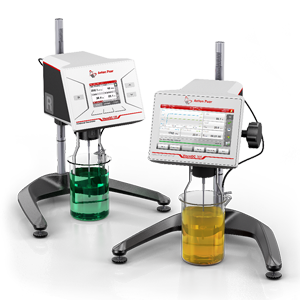
| Basic viscosity and rheological measurements |
The glue is too thin or too thick for the application. | Determine the viscosity of the material by performing quick quality control checks at a constant speed. | Adapt the consistency so that the glue is neither running off the surface that needs to be glued nor gets stuck in the tube. | |
The glue does not flow into the gap. | Determine the viscosity at a certain speed/shear rate. | Adjust the formula to decrease the viscosity for easier flowing into gaps. | |
It is not possible to spread the sealant on the gluing surface. | Determine the viscosity at different shear rates to simulate the behavior of the sealant at rest and during spreading it on the surface (application). | Knowing the viscosity at different shear rates you can adjust the flow behavior of the sealant at each stage of its usage (from squeezing it out of the tube to applying it on a clean surface). | |
It takes too long for the fixative to bond two surface areas. | Determine the time-dependent behavior at a constant rotational speed/shear rate. | Knowing the time the fixative takes to increase in viscosity, and thus to harden, helps you determine the right formulation. | |
The epoxy resin gets stuck while pumping or during application. | Analyze the yield point of the adhesive. | Adjust the formulation of the adhesive to lower the yield point of the sample so that less force is needed to e.g. pump it through the pipe. | |
The silicone glue flows off the gluing surface. | Analyze the structural decomposition and recovery of the inner structure of the silicone glue. | Adjust the formulation of the silicone glue to ensure that the viscosity recovers after application and stays on the gluing surface. | |
The adhesive shows phase separation or sedimentation after a certain time at rest. | Check the storage stability with a frequency sweep and thereby observe and avoid separation of the two phases within the material. | Prevent phase separation/sedimentation of the adhesive during long-term storage. | - MCR 92
- MCR 102e, 302e, 502e
|
The resin is too thick for the application at 40 °C. | Determine the viscosity at the application temperature. | Adjust the resin to its optimum application conditions. | |
A two-component adhesive hardens before application is finished. | Analyze the curing process to learn when the viscosity is doubled compared to the viscosity at the beginning of the reaction. | Adjust the formula of the material to reach a sufficiently long application period (starting from mixing the two components together). | |
| Advanced rheological measurements |
After application the glue hardens too fast before being spread on the surface. | Measure the time-dependent increase of viscous and elastic moduli during the hardening of glue with regards to physical drying or chemical curing. | Determine the onset of curing and the G’-G’’ crossover point to find out the maximum time available for glue application at ambient conditions. | - MCR 92
- MCR 102e, 302e, 502e
|
The hotmelt junction detaches when the room heating is switched on. | Determine the glass transition temperature and the melting temperature of the hotmelt with temperature sweeps. | Provide temperature windows suitable for application and upper/lower usage temperature limits. | |
With low UV light intensity the adhesive does not attain the required mechanical properties, and with high UV light intensity the energy consumption is too high. | Analyze the curing behavior of the UV adhesive with variable UV light intensity. | Trace the crosslinking reaction and adapt the UV light intensity in a way that the curing speed and final product quality are ideal. | |
The curing time of the construction adhesive differs when applied outdoors for rainy weather compared to sunny weather. | Adjust the humidity and temperature during the measurement to understand their effect on the curing of the construction adhesive. | Provide a possible range of humidities and temperatures at which the construction adhesive shows an acceptable curing time. | |
The adhesive tape breaks off when stretched under load. | Determine the DMA behavior of the film with amplitude sweeps and temperature sweeps. | Know the maximum load before the adhesive tape breaks off to specify qualified loads. | |
The particulate raw material cannot be pumped, segregates, or demixes during pumping or production. | Check the cohesiveness, segregation, and wall friction behavior of your granulate matter by using a powder cell or a shear cell. | Avoid segregation during transport and storage of powdery materials. | |