Learn more about ultra-low alcohol verification for 0.0 % beer. This FAQ section answers common questions about the Enzymatic Reader, covering the measurement technology itself, system integration, operational workflows, and complementary Anton Paar measurement systems.
Questions about measurement, operation, and reliability
How does the Enzymatic Reader ensure reliable sensor strip measurements?
The Enzymatic Reader uses dedicated single-use sensor strips designed to ensure consistent measurement performance and eliminate carryover effects between samples. If stored at the specified temperature and used within the shelf-life, further checks are not required.
How can operators verify correct system performance?
Positive controls and a dedicated test device support verification of system performance and help breweries document compliance-oriented workflows. When a new sensor batch is received, a one-time measurement of supplied reference materials is recommended.
Why are single-use strips beneficial?
Single-use strips eliminate the need for sensor regeneration or recalibration between measurements. This simplifies operation, reduces maintenance effort, and helps ensure reproducible results.
Do sensor strips require calibration before use?
No routine strip calibration is required. The system is designed for straightforward operation with minimal preparation effort.
How are sensors ordered and delivered?
Sensors can be ordered through your Anton Paar subsidiary, distribution partner, or the webshop. To prevent thermal stress during transport, sensors are shipped in cooled packaging and delivered within five days from dispatch.
Can I also use the Enzymatic Reader to analyze wine or other samples for alcohol content?
The use of the Enzymatic Reader with ethanol sensor strips has not yet been validated for alcohol-free wines and is therefore not currently approved. At present, the validated application is limited to alcohol-free beer.
Are there test strips available for analytes other than ethanol?
Currently, Anton Paar only offers ethanol sensor strips for the determination of ethanol in alcohol-free beer. Test strips for other analytes are currently not available.
Which measurement system should I use for different beer types?
How are alcohol-free and non-alcoholic beers defined?
The definition strongly depends on local laws.
0.0 % beer: This usually means the beer is intended to contain 0.0 % v/v or only trace alcohol close to zero. Most commonly, it must be possible to round the ethanol content to 0.0 % v/v, so the highest allowed alcohol level is 0.04 % v/v. Other countries require levels below that (e.g. 0.02 % v/v) for labelling products as “0.0%”.
Non-alcoholic beer: Often used similarly to alcohol-free beer, especially for beers with < 0.5 % v/v. At the EU level, there is no fully harmonized legal definition for low or no-alcohol beer; however, EU customs nomenclature recognizes “non-alcoholic beer” as beer with alcohol strength below 0.5 % v/v.
Alcohol-free: “Alcohol-free” does not always mean 0.00 % alcohol. It can still contain small residual alcohol up to the legal or market limit of up to a few % v/v.
Low-alcohol beer: Beer with reduced alcohol content, but typically above the alcohol-free/non-alcoholic threshold. The exact limit depends on country-specific rules.
Table 1. Typical definitions of alcohol levels (dependent on local legislation).
Term
Typical ABV meaning
Practical interpretation
0.0 or zero alcohol
< 0.02 or < 0.04
Stricter claim, closest to no alcohol
Non-alcoholic
≤ 0.5 % v/v
Often equivalent to alcohol-free
Alcohol-free
≤ 0.5 % v/v
Very low alcohol, not necessarily 0.00
Low-alcohol
> 0.5 % v/v
Reduced alcohol, but not alcohol-free
When should I use the Enzymatic Reader?
The Enzymatic Reader is designed for selective verification of ultra-low alcohol concentrations in 0.0 % beer below 0.05 % v/v. It is particularly suitable for final product release testing and for samples close to legal or internal specification limits.
When should I use the Alcolyzer?
The Alcolyzer is ideal for routine alcohol measurement across a broad concentration range, from non-alcoholic to alcoholic beers. It is especially well suited for fast, high-throughput QC measurements during the production of all beer types.
Why combine the Enzymatic Reader with the Alcolyzer?
The two technologies complement each other:
The Enzymatic Reader provides highly selective reference measurements in the ultra-low alcohol range required for 0.0% beer verification
The Alcolyzer enables measurement over the whole alcohol range. For 0.0% products, a one-time reference check is recommended
Together, they support efficient workflows for breweries producing both alcoholic and non-alcoholic beers.
Can the Enzymatic Reader be used as a reference for the Alcolyzer?
Yes. Breweries can use the Enzymatic Reader for selective low-range verification of 0.0% beer and the Alcolyzer for routine quality control measurements afterward.
Can the Enzymatic Reader replace the Alcolyzer for all non-alcoholic beers?
No. The Enzymatic Reader is optimized specifically for ultra-low alcohol verification below 0.05 % v/v. For higher levels of alcohol, the Alcolyzer is required. For routine measurement of “regular” beverages, the Alcolyzer is often the more efficient solution for daily QC workflows.
Why not use the Enzymatic Reader for all alcohol measurements?
The Enzymatic Reader is designed for highly selective low-level verification. For routine high-throughput alcohol analysis across broader concentration ranges, other measurement technologies such as the Alcolyzer may offer workflow and cost advantages.
Why not use the Alcolyzer alone for all 0.0 % beer applications?
Some beverage matrices may contain components that can influence non-selective measurement methods at extremely low alcohol concentrations. In addition, measurement of very low alcohol levels requires proper cleaning and calibration of the device. The Enzymatic Reader adds selective verification capability for applications where maximum confidence in ultra-low alcohol determination is required.
How do I ensure the alcohol content is below a threshold with statistical significance?
A calculation is included in the measurement systems. Two terms are important:
Compliance limit: The check limit is the maximum measured value that still confirms the sample is below the target limit after uncertainty is considered
Control limit: The control limit is the maximum measured value that still confirms the sample is below the target limit after uncertainty is considered
More information can be found on the Anton Paar Wiki page.
How does a measurement using the Enzymatic Reader work?
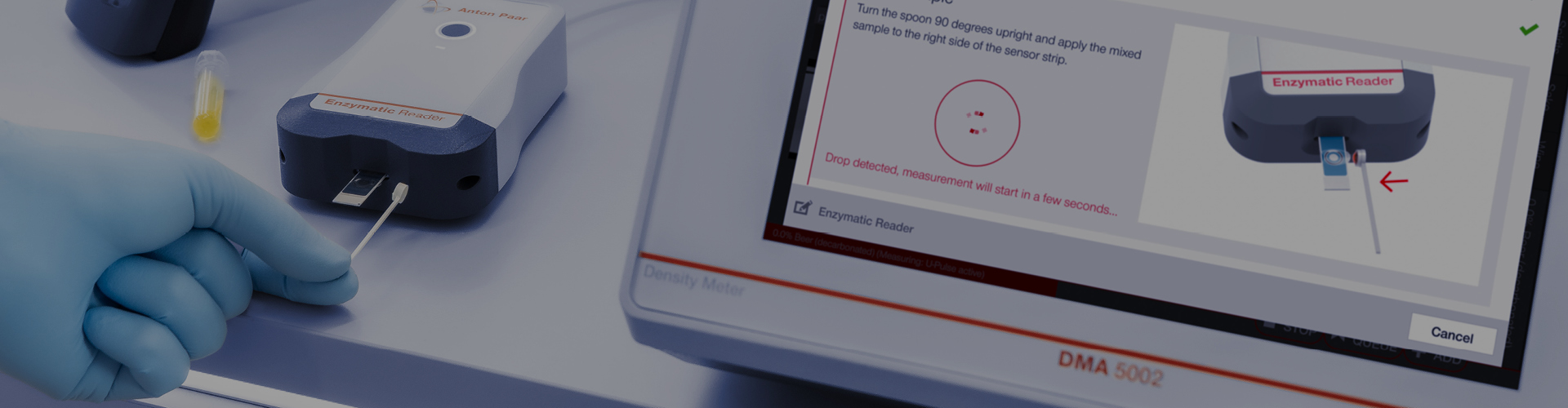
The measurement principle is based on an enzymatic reaction in which alcohol dehydrogenase (ADH) converts ethanol into acetaldehyde. The oxidation of ethanol is detected on the sensor strip by measuring the resulting electrical current, which is proportional to the ethanol concentration in the sample. A workflow guides users through sample preparation and measurement while the other modules are measuring. For the measurement, the sample has to be degassed, mixed with buffer (1+4) and applied with a spoon. If using an Alcolyzer module, this can be cross-referenced with the Enzymatic Reader. If required, an offset can be determined to fine-tune the Alcolyzer result depending on the sample matrix.
How do the Enzymatic Reader data compare to reference methods?
The data correlate well if they are analyzed carefully according to, e.g., MEBAK 9.3.1 (enzymatic method) or 9.3.2 (gas chromatography), generally with an accuracy of 16 % of the measured value or 0.0025 % v/v (whichever is greater). Significant differences can be caused by sample preparation and handling, as well as the analytical methods in place. It is crucial that all analyses are performed in parallel, as batch fluctuation, ethanol evaporation, and spontaneous fermentation upon contact of samples with air can affect the ethanol content of the sample.
How often is calibration of the Enzymatic Reader required?
The reader measures only current and voltage and therefore does not require calibration, provided its components are free from corrosion or damage. The sensors are single-use and include adjustment data encoded in a QR code. If they arrive undamaged and are stored according to specification, no further calibration is required.
Two checks should be conducted:
The Enzymatic Reader check with a supplied testing device to validate the functionality of the reader – required only upon installation and in case corrosion of internal parts is suspected.
The Enzymatic Reader 0.05 % v/v check to validate a sensor batch performance is recommended upon receiving a new batch. A pre-mixed standard of 0.05 % v/v with buffer is supplied with the sensors.
How does temperature influence the Enzymatic Reader measurement?
Temperatures below 18 °C can deactivate the enzyme and lead to low values, especially if the strip, buffer, or sample is too cold. The buffer should therefore be stored on the bench before use. Above 24 °C, values may increase slightly with higher temperature – the higher the alcohol content, the stronger the effect.
How do bubbles and filling affect measurement with the Enzymatic Reader?
A bubble on the central electrode can cause values to be too low, while a side bubble likely has little or no effect. Insufficient filling volume may also influence results, so filling should be done carefully without rushing: turn the spoon by 90°, place it over the lash, and move it upward slowly.
Why are measurement timing and sample handling important for measurement with the Enzymatic Reader?
Samples should be prepared directly before measurement, as delays can affect results. Samples stored for a longer period may show reduced ethanol content due to evaporation, but also spontaneous fermentation can happen upon contact with air, causing the ethanol levels to rise. In addition, high ethanol content in the atmosphere can also elevate the alcohol conten of samples when, e.g., stored open next to an opened flask of ethanol. Fill the sensor only when the guided workflow indicates it as the oxidation of ethanol will start immediately.
How long is the shelf life of the provided enzymatic sensors?
At least six months from date of dispatch when stored at 2 °C to 8 °C. The strips must not be stored at higher temperatures for long durations or outside of the sealed package.
Ready to simplify 0.0 % beer verification? Learn how the Enzymatic Reader helps breweries achieve reliable release testing with fast workflows, selective analysis, and seamless integration into Anton Paar measurement systems.
We use cookies on our website. Some of them are necessary (e.g. for the shopping cart), others help us make our online content better and easier for you over the long term via analysis, external media, and marketing services. We also use third-party cookies from providers in the USA like Google or Facebook if provided with your consent (Art. 49(1)(a) GDPR). Your data may be transferred to the USA which does not have a data protection level comparable to GDPR. In this case your data may potentially be accessed by US Authorities for surveillance purposes and you may not be able to exercise effective legal remedies. You can accept or reject all cookies by clicking on the respective button or define your cookie settings using the link "Customize your cookie settings".
If you reject all cookies, only technically required cookies will be used. You can also withdraw your consent at a later time by accessing the Cookie Settings.
Marketing cookies are used by third parties or publishers to show you personalized advertising. They do this by tracking which websites visitors go to.
Content from video platforms and social media platforms is blocked by default. If you accept cookies from external media, accessing these contents no longer requires giving manual consent.
After being informed of potential risks for my data (including transfer to the USA and potential access by US authorities) in the Cookie Banner and Privacy Policy I accept the cookies from US-providers.