The powder material, for example flour, tends to segregate or demix during the powder mixing process. | Analyze the segregation and wall friction behavior of your samples using the powder flow cell. | Avoid problems in the production process due to changed powder flow behavior by adjusting the formulation of the raw material. | |
Uncover the exact viscosity of the raw material gum arabic solution prior to processing to ensure e.g. adequate thickening/emulsifying/stabilizing behavior. | Perform quick single-point quality control checks and flow curve measurements. Also determine the yield point as a quality control parameter. | Find out the amount required to ensure the right viscosity of the raw material for its different applications. | |
How can I adjust the right viscosity of the raw material gum arabic solution at different temperatures to control different production stages? | Perform quick single-point quality control checks and flow curve measurements (temperature-dependent tests). Also determine the yield point as a quality control parameter. | Adjust the amount required to ensure the right viscosity for the different production stages according to the production temperatures. | |
Do the incoming liquid raw materials of my fruit juice/purees or syrup have the right viscosity? | Perform quick single-point quality control checks and multi-point determination of the flow behavior and the yield point for quality control. | Adjust the ingredients to guarantee efficiency in different production stages and the appropriate quality of the incoming liquid raw materials. | |
How can I reduce sugar or fat but maintain the same texture? | Measure a flow curve for different formulations and check whether you can reach the same viscosity as of the original product. | Texture and viscosity are related. Rheological tests are an easy and time-saving way to gain insight into food textures. | - MCR 72/92
- MCR 102e/302e
- MCR 702e MultiDrive
|
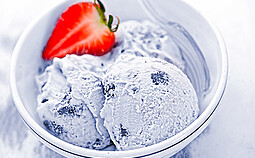
How can I predict the sensory attributes of ice cream (psychorheology)? | Performing an oscillatory temperature test (Oscillation Thermo-Rheometry, OTR) gives you access to the rigidity, creaminess, or even scoopability of the ice cream sample. | As sensory attributes strongly correlate with rheological quantities, it is essential to perform a rheological analysis in order to evaluate new formulations or for quality control. | - MCR 102e/302e
- MCR 702e MultiDrive
|
How can I adjust the right ingredients (emulsifiers or cocoa butter) for my chocolate products? | Perform single-point and viscosity curve measurements for quick quality control checks. | Choose the right ingredients of the chocolate to get the perfect consistency and texture for your chocolate products. | |
How can I follow the IOCCC method when it comes to the characterization of my chocolate products? | Conduct flow curves and temperature-dependent tests according to IOCCC. | Analyze the viscosity according to the IOCCC method. | |
How can I achieve the optimal conching process or coveraging of chocolate surfaces (in order to get even surfaces) when producing chocolate bars or chocolate products? | Carry out flow curve and yield point measurements at pre-defined temperatures. | Choose the right ingredients and amounts of ingredients for the chocolate to achieve perfect processing such as conching or coverage. | |
How can I choose the right type of milk (e.g. fat content or milk protein casein), concentration, composition, pre-treatment of milk, starter culture, and incubation temperature of yogurt and sour cream in order to ensure good processability? | Make quick single-point quality control checks and flow curve measurements and determine the yield point and thixotropic breakdown coefficient. | Adjust the ingredients to ensure the right viscosity for the different production stages. | |
How can I find the right viscosity of biscuit/bread dough to control the manufacturing and production process as well as the quality of the final product? | Determine flow curves (time- and temperature-dependent tests) as parameters for quality control. | Adjust the amount of ingredients to ensure the right viscosity for the final product and the different production stages. | - RheolabQC
- MCR 92
- MCR 102e/302e
- MCR 702e MultiDrive
|
How can I check the consistency of gluten-free bread dough? | Perform a frequency sweep within the linear viscoelastic range. | Make sure that the necessary 3D network structure, comparable with that of a standard bread dough, is created. | - MCR 92
- MCR 102e/302e/502e
- MCR 702e MultiDrive
|
How can I measure the rheology of a pudding gel without rupturing the sample? | Oscillatory frequency tests within the linear viscoelastic regime do not rupture the sample. | Performing rotational tests may break the structure of your sample. Performing oscillatory tests within the viscoelastic regime prevents the structure from breaking. If necessary, the Cox-Merz rule can be applied to derive the complex viscosity. | - MCR 92
- MCR 102e/502e
- MCR 702e MultiDrive
|
How can I determine the viscosity of my meat sauce that contains very large particles? | Perform a test with the specially designed Ball Measuring System. | The Ball Measuring System allows you to evaluate flow properties of samples with very large particles within one single rotation of the ball. | - RheolabQC
- MCR 72/92
- MCR 102e/302e
- MCR 702e MultiDrive
|
Can I measure the yield point of my Greek yogurt without destroying the structure during sample preparation? | Use a four-blade stirrer with sharpened blades as the measuring system. | The sharpened blades will gently move through the yogurt without squeezing and irreversibly changing the structure of the bulk yogurt. | - MCR 72/92
- MCR 102e/302e
- MCR 702e MultiDrive
|
How can I determine the pasting temperature and final viscosity of starches? | Use the Anton Paar Starch Cell to analyze the starch pasting and gelatinization behavior at elevated temperatures. | The high heating and cooling rates required for starch pasting measurements are achieved by combining electrical heating with fluid-circulator-supported cooling. A special stirrer prevents sedimentation in the liquid phase. | - MCR 72/92
- MCR 102e/302e
- MCR 702e MultiDrive
|
How can I observe the dynamics of emulsion droplets during shearing? | Use the MultiDrive-microscopy accessory. Run a rotational or oscillation test and observe the droplet behavior during the measurement. Employing the counter-rotation mode of the TwinDrive rheometer you can focus on a stagnation plane between the two plates, which allows you to observe the same droplet throughout the entire test. | The droplet break-up helps you understand the stability of droplet microstructure in an emulsion under varying conditions. | |
How can I ensure high surface quality of packaging film without surface damages (e.g. a rippled surface)? | Perform rheological measurements to characterize the viscoelasticity of the used raw material in order to optimize process conditions. | You obtain consistent quality of the produced films, without surface imperfections or defects. | - MCR 92
- MCR 102e/302e
- MCR 702e MultiDrive
|
How can I ensure that the packaging film used for various foods (in contact with water or oil) and under different environmental conditions (tropical/arid/cold climates) shows constant quality over the whole shelf life? | Analyze the mechanical performance of the film in DMA tests under controlled temperature, varying humidity conditions, or in immersion. | You get the guarantee that your product reaches your customer in good condition, independent of climate conditions and possible interactions between packaged food and packaging material. | - MCR 302e
- MCR 702e MultiDrive
|
How can I ensure that the packaging film does not rupture during use? | Perform tensile testing to determine the strain- or stress at break. Perform dynamic mechanical analysis to investigate film brittleness (as indicated by the measured damping factor). | You achieve improved product quality based on a better selection of materials tailored to the product requirements. | - MCR 102e/302e
- MCR 702e MultiDrive
|
How can I ensure the proper viscous and viscoelastic properties of my PET and recyclates or additional barrier materials to produce suitable preforms for beverages with injection molding? | Perform rheological tests to determine the shear rheological and extensional rheological properties of the raw materials. | Knowing the rheological properties enables the production of well layered preforms to ensure a stable production process and constant product properties of bottles used for beverages (e.g. constant low gas permeability). | - MCR 302e
- MCR 702e MultiDrive
|
How can I get suitable material parameters to optimize the processing conditions and mold design for the production of blow-molded and extrusion-blow-molded plastic bottles. | Determine relevant rheological parameters with shear rheological and extensional rheological testing methods. | Ensure high product quality with an optimum of material and production costs. | - MCR 302e
- MCR 702e MultiDrive
|
How can I find the right PET grade for my food/beverage packaging application (e.g. beverage, film, etc.)? | Measure intrinsic viscosity as PET grades are defined by intrinsic viscosity. | You get automatic calculation of intrinsic viscosity (and many other polymer parameters) without an external PC. Additional benefits are: reduced operating costs (low sample, solvent, and energy consumption) and excellent chemical resistance. | - Lovis 2000 M or Lovis 2000 ME
|
How can I ensure that the spices in my salad sauce will not sediment during storage? | Evaluate the rheological properties with an oscillatory frequency sweep. At low frequencies you can check whether your formulation forms a 3D structure. The slope of the elastic modulus should tend to 0. | Easy and time-saving rheological tests (like a stability test) can replace longstanding storage tests. | - MCR 92
- MCR 102e/302e
- MCR 702e MultiDrive
|
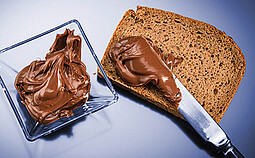
How can I find the right formulation/ingredients for my hazelnut cream so that it can be easily spread on the bread? | Estimate the shear rate at which the hazelnut cream is spread over the bread. | Find out the right consistency and viscosity so that the hazelnut cream is easily spreadable on the bread. | |
How can I find and create the perfect mouthfeel (psychorheology) for a hazelnut cream? | Determine the viscosity at different shear rates and temperatures. | Adjust the ingredients to ensure that the hazelnut cream has the desired mouthfeel for the customer. | |
How can I obtain a solid behavior for my jam so that it does not immediately flow out when spooned? | Perform a multi-point determination of the yield stress as a quality control parameter for flow behavior. | Change the consistency in a way that the jam stays on the spoon and does not run off, but also that it is easily spreadable on the bread. | |
How can I prevent ketchup/mayonnaise from flowing down my french fries? | Use the 3 interval thixotropy test to simulate the emptying of the bottle and check your different formulations. | Measure the viscosity under very different conditions (rest – high shear – rest) with the 3ITT test to study the structure recovery. | - RheolabQC
- MCR 92
- MCR 102e/302e/502e
- MCR 702e MultiDrive
|
When pouring mayonnaise out of the bottle, it has to flow out easily. | Determine the yield point as a quality control parameter. | Adjust the ingredients to ensure the right viscosity to get the mayonnaise out of the bottle. | |
I need to find the desired but also the appropriate feeling of drinkability (psychorheology) for clinical nourishment products for patients with swallowing problems (dysphagia). | Perform quick single-point quality control checks and multi-point determination of flow behavior. | Adjust the ingredients and their quantity to ensure the right viscosity to avoid issues with drinkability. Find the optimal smooth mouthfeel for the customers. | |