
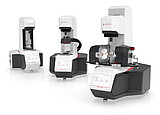
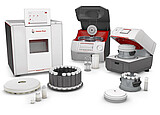
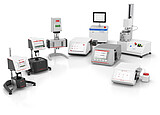
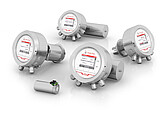
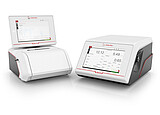
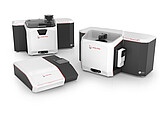
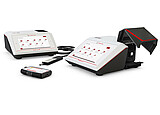
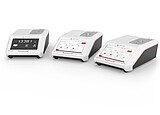
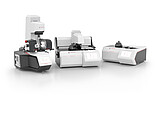
Physica MCR Rheometer Series
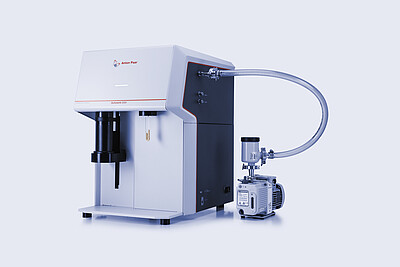
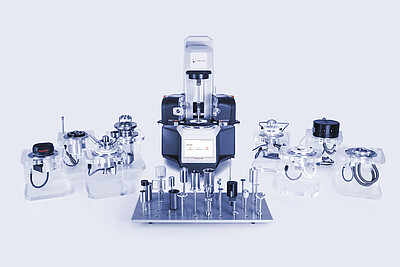
The Physica MCR rheometers are based on a concept at the cutting edge of technology. The EC motor technique, the low friction bearing and the patented normal force sensor have been optimized over years to satisfy the highest demands of rheologists. Any type or combination of rheological tests, both in rotational and oscillatory mode, are possible with the Physica MCR rheometers. The modularity of the system allows the integration of a wide range of temperature accessories and special modules. The innovative and patented features Toolmaster™ and TruGap™ are breakthroughs in terms of user-friendliness.Technical highlights
- Powerful, synchronous EC motor drive
- High-precision air bearing, including patented sensor for normal force measurement
- TruGap™: Innovative and patented system for measuring the gap
- Real-time position control oscillation (DSO): Fast and accurate strain control
- Nanorheology for nanomaterial science
- Different MCR models with outstanding specifications for various applications
Ease of use
- Toolmaster™: Patented system for automatic recognition of measuring system and accessories
- Quickfit coupling: Easy, one-hand measuring system connection
- Wide range of measuring systems for all kinds of applications
- Ethernet connection for remote control of the instrument through the company network
- RheoPlus: User-friendly application software with 21 CFR Part 11 compatibility and LIMS/SAP interface
Wide range of accessories
- Temperature accessories in the temperature range from -150 °C to +1000 °C
- Special accessories for DMA and DMTA measurements, rheo-optics, magneto- and electrorheology, interfacial rheology, UV curing and many other applications
Industries
- Beverages
- Chemical Industry
- Cosmetics, Personal Care
- Education, Research
- Electronics
- Environmental
- Food Industry
- Materials Science
- Minerals, Mining, Raw Materials
- Paper, Textiles
- Petroleum Industry
- Pharmacy, Medicine/Biotechnology
All instruments of the Physica MCR series are equipped with the Toolmaster™ system for automatic recognition of the measuring system and accessories. All systems are interchangeable between the different models.
|
Technical Data
|
Unit | Physica MCR 51 | Physica MCR 101 | Physica MCR 301 | Physica MCR 501 |
|
Bearing
|
Ball | Air | Air | Air | |
|---|---|---|---|---|---|
|
EC motor
|
Yes | Yes | Yes | Yes | |
|
Min. torque rotation
|
µNm | 250 | 0.1 | 0.05 | 0.05 |
| Min. torque oscillation | µNm | - | 0.1 | 0.01 | 0.01 |
| Max. torque | mNm | 125 | 150 | 200 | 230, 300* |
| Torque resolution | nNm | 100 | 0.2 | 0.1 | 0.1 |
| Angular deflection (set value) |
µrad | 1 to ∞ | 1 to ∞ | 0.1 to ∞ | 0.1 to ∞ |
| Angular resolution | µrad | 0.01 | 0.01 | 0.01 | 0.01 |
| Min. speed (CSS) | 1/min | 10-5 | 10-6 | 10-7 | 10-7 |
| Min. speed (CSR) | 1/min | 10-3 | 10-5 | 10-7 | 10-7 |
| Max. speed | 1/min | 3000 | 3000 | 3000 | 3000 |
| Min. angular frequency | rad/s | 10-3 | 10-5 | 10-5 | 10-5 |
| Max. angular frequency | rad/s | 628 | 628 | 628 | 628 |
| Normal force range | N | - | 0.1-30 | 0.01-50 | 0.01-50 |
| Normal force resolution | N | - | 0.02 | 0.002 | 0.002 |
| Max. temperature range | °C | -150 to +1000 | -150 to +1000 | -150 to +1000 | -150 to +1000 |
| Automatic gap setting (AGC/AGS) | - | Yes | Yes | Yes | Yes |
| TruGap™ | - | No | No | Optional | Yes |
| Direct Strain Oscillation (DSO) | - | No | No | Optional | Yes |
| Sample strain control (virtually compliance free) | - | No | Yes | Yes | Yes |
| Sample torque control (virtually inertia free) | - | - | Yes | Yes | Yes |
| Gap control (normal force and velocity); Tack und Squeeze | - | No | Optional | Yes | Yes |
| *MCR501/300 with max. 300 mNm available
on request **display and storage |
|||||
Select your industry and application to see the list of relevant accessories.
Most of the documents in this area can be downloaded directly. For some documents you need to register and then send a request to Anton Paar. Your download request will be processed as soon as possible by the responsible sales partner.
Application specific documents
Select your industry and application to see the list of relevant documents.
Common documents
A new ball measuring system for large particle suspensions
A new ball measuring system is brought to market which provides new opportunities to conduct rheological measurements on large particle suspension, paste-like substances and multi-phase systems which were not accessible to reproducible measurements with standard shear geometries. Flow curve ...
Asphalt and Bitumen - Behavior of bitumen in the temperature range of 0 ºC to +70 ºC
Bitumen has to be characterized rheologically in the temperature range of T = 0 up to +70 °C. The sample’s state modifies under these conditions. A solid-like, rigid body becomes a free-flowing melt ...
Calculation of the relaxation time(s) and the relaxation time spectrum H() of a polypropylene melt
The relaxation time spectrum H() is the rheological equivalent of the molar mass distribution MMD. It is a mathematical model based on the theory that a “rheologically simple” viscoelastic liquid whithout branching, cross linkage or gel character can easily be simulated by a combination of ...
Calculation of the weight average molar mass Mw based on the zero-shear viscosity measurement using a frequency sweep
This application note describes how to calculate the molar mass Mw based on the Zero-Shear Viscosity value measured in a Frequency Sweep. The Zero-Shear Viscosity can be evaluated by applying the Carreau-Yasuda Regression to a Frequency Sweep. With the example of two Polypropylene melts it is ...
Comparison of a Polypropylene PP reinforced with glass fibers and a pure Polypropylene over a temperature range from -150°C to +
Using a DMTA measurement in torsion allows the measurement of the improved mechanical and thermal properties of a PP sample reinforced with glass fibers in comparison to a pure PP sample. Due to the low loss factor and the higher modulus values compared to the pure PP sample, the reinforced sample ...
Comparison of linear and branched Polyphenylsulfone PPSU in film and granular form
A linear and a branched polymer were characterized with respect to its mechanical properties and structure. The measuring procedure can be applied in a fast and easy way. Polyphenylsulfone or Polyphenylsulphone (PPSF or PPSU) is a type of moldable plastic often used in rapid prototyping and rapid ...
Comparison of Polyethylene PE Melts Using Frequency Sweeps
A method is introduced for a characterization of polymer properties with respect to their molecular structure and processing behavior during thermoplastic processes such as Blown / Cast Extrusion, Extrusion Blow Molding or Injection Molding. The procedure can be applied in a fast and easy way. In ...
Comparison of Polypropylene PP Melts Using Frequency Sweeps
A method is explained to characterize polymer properties with respect to their structure and processing behavior during thermoplastic processes such as Film Extrusion, Extrusion Blow Molding, Injection Molding. The procedure can be applied in a fast and easy way ...
Comparison of the 'thixotropic behavior' of two textured coatings: Structural regeneration, surface leveling and sagging behavio
The application behavior of two textured coatings is investigated. Structural regeneration, surface leveling and sagging behavior are significant quality characteristics for coatings. These characteristics are also referred to as ‘thixotropic behavior’ and contribute substantially to whether a ...


Comparison of two epoxy resins EP composites in the temperature range from +25°C to +200°C. Dynamic Mechanical Thermal Analysis
Nano Composites: The thermal and mechanical behaviour of a pure epoxy resin and an epoxy resin reinforced with glass fibers should be investigated in the glass transition range and the rubber-elastic range. Using a DMTA measurement in torsion allows the measurement of the improved mechanical and ...
Comparison of two spray paints
Two spray paints which showed differences in their application concerning surface quality, have to be characterized rheologically. Flow and viscosity tests made before have not shown any significant differences in the measured results ...
Curing Process of Epoxy Molding Compounds
Epoxy Molding Compounds EMC are used in microelectronics industry for encapsulation purposes for a variety of semiconductor devices, for example in electronic packaging to protect the delicate wire bonds and other interconnects around an IC chip. Voids as well as fracture toughness of the bonds ...
Determining the rheological properties of pharmaceutical products - microemulsions (base for lotions and gels)
This report presents different rheological methods which can be used for characterizing gels and lotions. The described methods include flow and viscosity curves, the „yield point“, structural regeneration („thixotropy“) and determination of temperature-dependent behavior. The measuring ...


Determining the yield point and viscosity of chocolate (RheolabQC)
This report describes a measuring method for determining the yield point of chocolate. The yield point influences the way the chocolate levels out and how it melts in the mouth and on hands. Chocolate makers are also very interested in the spatial distribution of the cocoa butter molecules. They ...
Determining the yield point and viscosity of cosmetic products Example: Hair gel (RheolabQC)
Hair has a particular importance for us: It is an expression of beauty and individuality, but can also show affiliation to a culture or group. Modern hair gel must meet high requirements: Extremely strong, moisture-resistant and long-lasting hold which does not lead to sticky hands or sticky hair. ...
Flow and viscosity curves of polymer solutions
The flow behavior and the shear viscosity of a glue solution have to be examined at ambient temperature within a large shear rate range ...
Getting the zero shear viscosity of polymer melts with different rheological tests
The zero shear viscosity of a polymer melt was determined with different rheological tests like flow and viscosity curve, creep, frequency sweep and stress relaxation. All tests were performed with the same rheometer which was equipped with an electronically commutated synchronous motor allowing ...
Guideline for Pressure Cell
The pressure option for the MCR rheometer consists of a pressure cup, pressure head and magnetic coupling. As the pressure cell has to be sealed to apply pressure, the pressure head contains a mechanical bearing in addition to the bearing of the instrument. The geometry is attached to the mechanical ...
How to calculate the relaxation modulus G(t)
Several rheological functions like storage modulus G', loss modulus G'' or damping factor tan(delta) can be measured. An oscillation test describes the elastic and viscous behavior of any material but the results do not show time dependence. The user only gets information about frequency dependence ...
Identification of flow and structure properties by combining small angle light scattering (SALS) and rheology
Rheological measurements provide information about the macroscopic behaviour, but cannot give further information about the inner structure of a sample. The macroscopic behaviour depends usually on the microscopic structure of a sample. Conclusions from rheological measurements to the microstructure ...
Investigation of a Polymethylmethacrylate PMMA over a temperature range of -150°C to +160°C. Dynamic Mechanical Thermal Analysis
The rheological behavior of a PMMA sample is to be investigated over as wide a temperature range as possible. The aim of the investigation is to determine and discuss the glass transition zone and relaxation processes as important variables for the characterization of the material behavior ...
Magneto Sweep - A new method for characterizing the viscoelastic properties of magnetorheological fluids
The viscoelastic properties of a magneto-rheological fluid can be variably controlled using a magnetic field. A new measuring method is introduced which is based on oscillatory tests. In contrast to flow curves from experiments at steady shear rate, the new method allows an exact determination of a ...
Measuring the glass temperature of a polyethylene HDPE sample. Dynamic Mechanical Thermal Analysis (DMTA) in Torsion Tests.
The glass temperature of a highly dense polyethylene HDPE solid sample is to be investigated using a Physica MCR rheometer and the Solid Rectangular Fixture SRF. In contrast to other measuring methods (DSC), dynamic mechanic thermal analysis (DMTA) enables a practically relevant dynamic load to be ...
Modern Rheology Measurements In Today's Coatings Industry (18 p.)
Presentation ECS 2005 in cooperation with Elementi ...
Modern Rheology Measurements in Today's Coatings Industry (7 p.)
Summary of the presentation at ECS 2005 (in cooperation with Elementis ...
Nano-Rheology with the Physica MCR Series
For testing and developing progressive new materials such as nano emulsions and nano dispersions it is essential to use a modern rheometer with nano capabilities ...
New possibilities for frequency sweeps
The continuous development of the reliable Physica MCR technology enables you to achieve even more from the attainable frequency ranges ...
New rheological measuring possibilities: Advantages for application technology
Conventional rheometers can control either the speed (or angle deflection) or the torque. This article explains the advantages of electronically commutated (EC) rheometers with a synchronous motor. Results are presented which are relevant to application technology and have been determined using ...
New rheological test method to determine the dewatering kinetics of suspensions
Rheology plays an important role in dewatering processes. It is therefore interesting to analyze the dewatering process and the rheological behavior of a suspension simultaneously. An exact determination of the immobilization point at the maximum of the loss factor as well as the immobilization time ...
Practically relevant rheological analysis of polymers using a modern rheometer
Rheological investigations are very useful for developing technical polymers. Simple rheological measurements can be used in the quality control checks of raw materials and final products. Molecular structure and therefore the behavior of polymers during processing can be determined within a few ...
Processing behaviour of Polystyrene PS: Time Temperature Superposition - Master Curve
A method is explained to characterize polymer properties with respect to their structure and processing behavior during thermoplastic processes such as Injection Molding, Extrusion, Foam Extrusion, Sheet Extrusion and Thermoforming. Using the rheological standard test methods flow curve or frequency ...
Reducing the cost of lime cement plaster by selecting appropriate methylcellulose combinations
The cost of construction materials is highly dependent on the additives used. An important task in many research and development laboratories is therefore to replace the additives with less expensive ones, without considerably changing the properties of the material. Here, the influence of ...
Relaxation test permitting to calculate the complex viscosity function resp. zero shear viscosity
The oscillation test serves to characterize a substance regarding its viscous and elastic behavior. In addition to that it allows to measure the zero shear viscosity especially of polymer melts. A material's zero shear viscosity is determined at very low frequencies. In the range of zero viscosity ...
Rheological characterization of paper coatings
When applying paper coatings via applicator rolls the aim is to produce a homogenous and uniform coating thickness. To achieve this the paper coatings need to have certain physical-chemical properties. The surface tension has a great influence on the behavior during coating, as do the internal ...
Rheological Studies on Bituminous and Asphalt Binders used for Road Engineering
Road pavements permanently are strongly subjected to wear thus representing a considerable cost factor for road construction authorities. Therefore, intensive basic research on the various building materials used to improve the performance and lifetime of pavements is highly significant especially ...
Rheological tests round the clock! Measurements with the automatic sample changer ASC 32
"Everything takes too long", thinks laboratory manager Ms. C. It is her job to inform the company of the results of routine viscosity measurements for Quality Assurance (QA). Since the production line began running at night, Ms. C. has been on the look-out for a way of carrying out the QA tests ...
Spoonability of yoghurt and other foods
This report describes a measuring method for determining the spoonability of yogurt and other foods. Besides classical rheological characterization using a stirrer or cylinder geometry, this test provides information on the sensory properties of the food ...
Temperature-Dependent Rheology of Lubrication Greases
Oscillatory amplitude sweeps are very well suited to investigate the visco-elastic behavior and consistency of lubrication greases. The measurements are showing an excellent reproducibility. Valuable information on the storage and the loss moduli as well as on the stress values at the flow point ...
The Rheology of Hotmelt Adhesives
One of the best ways to study the rheological behavior of hot melts is through dynamic oscillatory measurements. This technique involves oscillating, or twisting, the material at different frequencies and amplitudes and studying the resultant behavior. Use of this technique enables the user to ...
Thermal behavior of a rubber-elastic polymer
The two modified PVCs are used at low temperatures for lamella door systems in cold storage houses. For trucks it shall be possible to pass these flexible lamella doors without problems or even destruction. In this case the materials must be sufficiently strong and flexible at low temperatures. It ...
Time- and frequency-dependent measurements on printing inks
Comparison of three printing inks as regards yield point, flow properties and thixotropy. The task is to define a suitable measuring procedure which takes a maximum of 20 minutes ...
Tribology on MCR Rheometers: Introduction and Measurements
Lubrication and wear is of high importance in our daily life. In technical applications friction is usually an unwanted effect as it is related to loss of energy and reduction of lifetime of mechanical parts. On the other hand for some applications as e.g. tires, friction is definitely required. The ...
Using Vane Fixtures in a Rheometer
Rheometers are sophisticated instruments that apply precise deformations to materials and measure the torque of the mechanical re-sponse. Or, the applied stress can be preset and the resulting sample deformation meas-ured. The same instrument can test thin liquids or thick solids as long as the ...
Variable cone truncation of cone & plate measuring systems as a function of cone angle and cone diameter
Until now all cone & plate measuring systems from Anton Paar were manufactured using the same cone truncation -> any cone below 1° cone angle with a cone truncation of about 20µm -> cones starting with a cone angle of 1° with a cone truncation of about 50µm. The constant cone truncations for ...
Working with the Solid Rectangular Fixture SRF and the Convection Temperature Device CTD600
This technical note shows some hints and typically settings for getting started with the solid rectangular fixture and the convection temperature device ...
Yield point and viscosity to describe the pumping and transporting process of slurries Example: Kaolin suspensions (RheolabQC)
The processing characteristics and transport characteristics of slurries are heavily dependent on their rheological properties. Knowledge of the rheological parameters is therefore essential, particularly when transporting large amounts of slurry. This report describes a measuring method for the ...
Literature - The Rheology Handbook
Second Edition ...
Second Edition ...
| icon | title | size | status |
|---|---|---|---|
| Instruments - Physica MCR xx0 Series | [en, 545.90 KB] | ||
| Instruments - Physica MCR xx1 Series | [en, 785.33 KB] | ||
| Rheometer Software - Rheoplus Version 3.x - 21 CFR Part 11 | [en, 646.18 KB] | ||
| Rheometer Software - Rheoplus Version 3.x - ASC Software | [en, 848.26 KB] | ||
| Rheometer Software - Rheoplus Version 3.x - Direct Control Interface | [en, 891.64 KB] | ||
| Rheometer Software - Rheoplus Version 3.x - LIM/SAP Interface | [en, 392.85 KB] | ||
| Rheometer Software - Rheoplus Version 3.x - Status Messages | [en, 66.26 KB] | ||
| Rheometer Software - Rheoplus Version 3.x - Volume 1 - Installation and Introduction | [en, 590.49 KB] | ||
| Rheometer Software - Rheoplus Version 3.x - Volume 2 - Reference Manual | [en, 2.67 MB] | ||
| Rheometer Software - Rheoplus Version 3.x - Volume 3 - Analysis | [en, 6.89 MB] | ||
| Rheometer Software - Rheoplus Version 3.x - Volume 4 - Device Driver MCR (51, 101, 301, 501) | [en, 835.84 KB] |