The Adolphe Merkle Institute, part of the University of Fribourg in Switzerland, brings together around 100 scientists across six research groups. Its work focuses on fundamental and application-oriented research in soft nanomaterials.
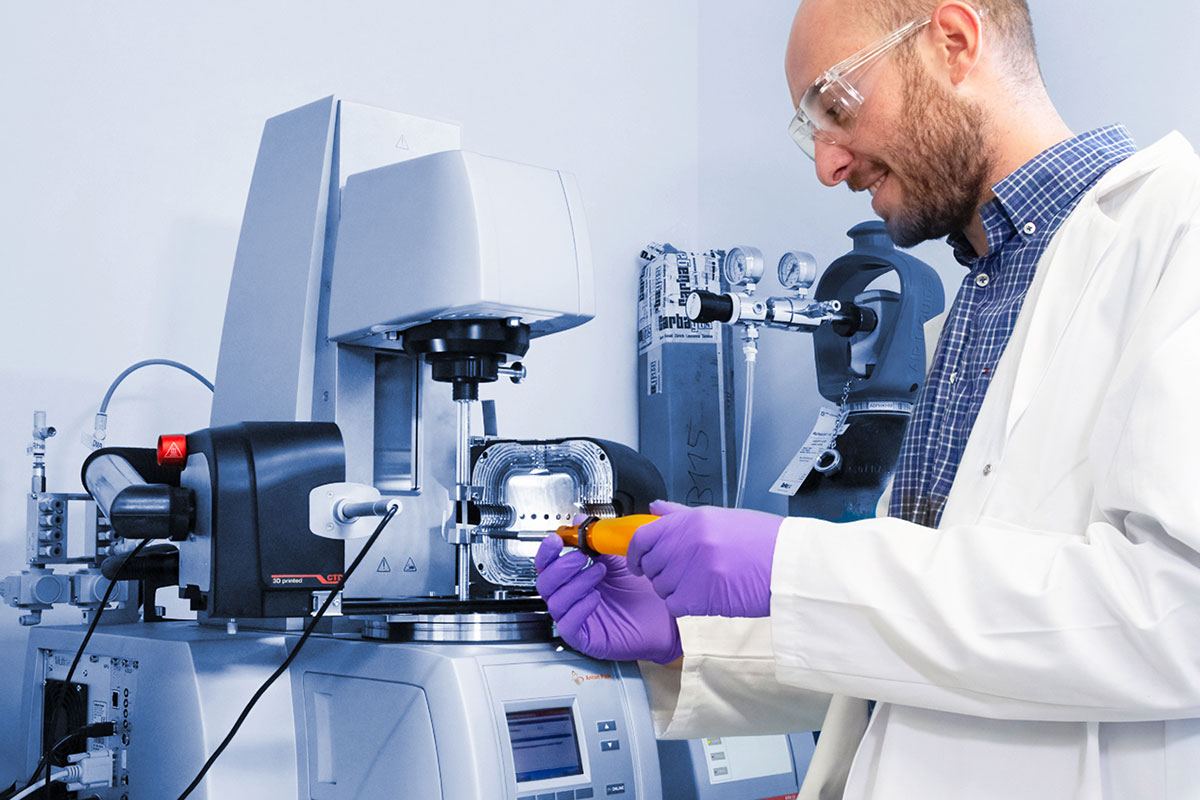
One research group led by Christoph Weder, Professor of Polymer Chemistry and Materials and former director of the AMI, develops new polymers and polymer-based materials for future applications. Andrea Dodero, Group Leader in Soft Matter Physics, uses Anton Paar’s MCR 702 MultiDrive to characterize these novel materials.
Rheology and DMA on one instrument
Before purchasing MCR 702 MultiDrive in 2020, AMI performed rheological measurements and dynamic mechanical analysis on separate instruments. With MCR 702 MultiDrive, both techniques can now be carried out on a single platform.
This gives the AMI more complete information about the materials prepared in the lab. It also increases the number of samples the team can measure per day and allows researchers to develop personalized tests with high accuracy.
Studying stimuli-responsive polymers
The AMI uses MCR 702 MultiDrive to investigate stimuli-responsive polymer systems. These materials are designed to change properties under external stimulation (e.g., with light). The instrument’s camera port allows researchers to illuminate samples while mechanical tests are running, making it suitable for studying light-induced changes.
The institute performs DMA in bending, tension, compression, and torsion, as well as mechanical testing and rheological measurements. Samples include stimuli-responsive polymers and polymers in general.
A versatile “workhorse” for material characterization
For the AMI, the decisive advantage of MCR 702 MultiDrive is versatility. The instrument supports a broad range of samples and properties, while accessories such as the additional linear drive, the CTD 600 MDR convection temperature device, the low-temperature option, and the DigiEye 250 camera system extend its application scope.
By bringing rheology in-house, the AMI gains direct access to reliable material data and a flexible platform for ongoing polymer research.