Ointment Consistency

Ointment Consistency
Reliable Results for Pharmaceutical and Cosmetic Products
Ointment consistency determines not only how a formulation feels and spreads on the skin but also how it performs. Using standardized methods such as European Pharmacopoeia 2.9.9, Anton Paar penetrometers ensure reproducible and traceable results for creams, gels, and ointments – supporting product quality from development to production control.
What is ointment consistency?
Ointment consistency describes the firmness or softness of a semi-solid formulation such as creams, gels, or ointments. It determines how easily a product spreads on the skin, how stable it remains during storage, and how it performs in use. A well-balanced consistency is essential for both pharmaceutical and cosmetic products, influencing user experience, stability, and overall product quality.
What influences ointment consistency?
The consistency of an ointment is influenced by its formulation components and manufacturing conditions. The ratio of base materials, emulsifiers, and active ingredients, as well as temperature and shear during mixing, all affect texture and firmness. External factors such as storage time and temperature can further change consistency, making reliable measurement crucial for ensuring uniform quality and performance across batches.
Why Consistency Matters

Texture and spreadability
Consistent texture ensures uniform product appearance and reliable spreading behavior, ensuring smooth application and stable performance throughout the product’s shelf life.

Absorption and performance
Ointment consistency defines how fast an ointment is absorbed or how long it remains on the skin, directly influencing therapeutic effectiveness and user comfort.

Regulatory compliance
Well-defined consistency guarantees reproducible product performance and stability, meeting strict regulatory demands for quality and patient safety as per, e.g., Ph. EU 2.9.9, USP 915, and USP 1912.
How to measure ointment consistency
While texture analyzers or rheometers can assess semi-solid properties, especially focusing on deep material research to understand ointment flow and deformation behavior, penetrometry remains the preferred method defined in pharmacopeial standards for ointment consistency, when it comes to quick QC checks.
Unlike rheological testing, penetrometry involves quick, standardized firmness checks. It’s fast for QC, easy for anyone to perform, and offers everything you need for simple firmness comparisons rather than a deep dive into material structure.
Anton Paar’s PNR 500 is simple to operate, follows standardized methods, and has accessories tailored to pharmaceutical and cosmetic products – ensuring traceable results without complex data interpretation.
| Method | What it measures | Key outputs | Typical setup | Best used for |
| Penetrometry | Resistance to a standardized probe entering the sample | Penetration units (PU) = 0.1 mm depth; firmness/consistency class | Hollow cone / micro-cone (mass and penetration time defined), container, controlled temperature | Preferred pharmacopeial QC method (Ph. Eur. 2.9.9); release testing; quick batch-to-batch comparability |
| Texture analysis | Force needed to deform, extrude, or separate the sample | Peak force (N or g), work/area (spreadability), adhesiveness/tack, cohesiveness | Compression/back-extrusion cells, spreadability rigs, tack probes | Handling and sensory surrogates: spreadability, tack, ‘feel’ during application |
| Rheometry | Flow and viscoelastic behavior under controlled shear/strain | Viscosity vs. shear rate, yield stress, G′/G″, thixotropy (loop area) | Cone-plate or parallel-plate (often roughened), temperature control | Formulation and stability: pumpability, sag resistance, storage/transport behavior |
PNR 500: reliable ointment consistency testing
The PNR 500 penetrometer is Anton Paar’s most advanced solution for measuring the consistency of ointments, creams, and gels. For applications such as testing of ointments and creams, the PNR 500 can be used effectively thanks to its easy handling and convertibility. A wide range of interchangeable test bodies – including hollow cones, micro cones, ½ cones and ¼ cones – allows perfect adaptation to various consistencies, from soft cosmetic lotions to highly viscous pharmaceutical ointments. Comprehensive IQ|OQ|PQ documentation supports quick qualification and full traceability in regulated environments.
Standardized method according to pharmacopeia
Consistency testing of ointments follows pharmacopeial methods, such as European Pharmacopoeia 2.9.9, which define measurement by penetrometry – a process where a hollow cone or micro cone penetrates the sample under defined conditions. The resulting penetration depth, expressed in penetration units (PU), characterizes the product’s firmness and spreadability, ensuring comparability and regulatory conformity.
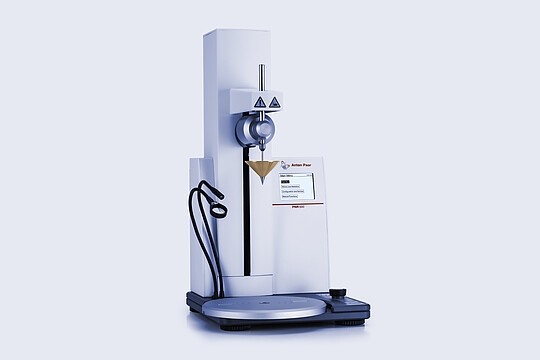
Advantages for ointment consistency testing with PNR 500
- Small sample volume (~4 mL)
- Short tempering time; bubble-free filling
- Environmentally friendly cleaning
- High reproducibility and repeatability
- Ideal for ointment and cream testing

Tailored test bodies for every formulation
Anton Paar offers more than 200 interchangeable test bodies to cover the entire range of consistencies, from soft lotions to highly viscous ointments and gels. For pharmaceutical products, the micro cone kit is the preferred choice, requiring only a few milliliters of sample while ensuring excellent reproducibility. Depending on product type and standard, other test bodies such as discs, or cones are available, each designed for specific sample behaviors and penetration depths.
Key industry applications

Pharmaceuticals
Topical drug formulations require consistent texture for proper dosing and absorption. Consistency testing ensures homogeneity, stability, and compliance with USP and EMA standards.
- Examples: prescription ointments, compounded creams, transdermal gels
- Key testing methods: rheometry, penetrometry

Cosmetics and personal care
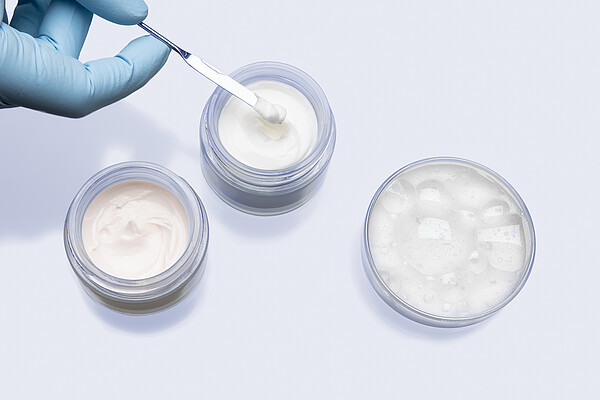
Product feel and spreadability are central to consumer satisfaction. Consistency analysis helps optimize formulations for skin feel, shelf life, and visual appeal.
- Examples: moisturizers, balms, sunscreens, deodorant sticks
- Focus areas: sensory consistency, thixotropy, product differentiation
Veterinary care
Topical animal treatments require robust textures that adhere well under varying conditions. Consistency ensures accurate application and treatment retention.
- Examples: antiseptic creams, barrier ointments, paw balms
- Considerations: adherence, environmental resistance, dosing control

Research and development
R&D labs use consistency testing to develop stable, scalable formulations. Rapidly produced, precise data supports formulation optimization and quality-by-design strategies.
- Use cases: prototype screening, excipient evaluation, preclinical testing
Example: Measuring a cream with a PNR penetrometer from Anton Paar
In a practical example, a cream was tempered to 25 °C and tested using the micro cone kit. The penetration time was 5 seconds with a total test load of 25 g. The average result of three measurements showed consistent values around 112 PU, confirming excellent reproducibility.
From pharmaceutical ointments to cosmetic creams, product consistency defines quality and usability. PNR 500 delivers precise, reproducible results across all formulations and ensures full traceability in regulated environments.