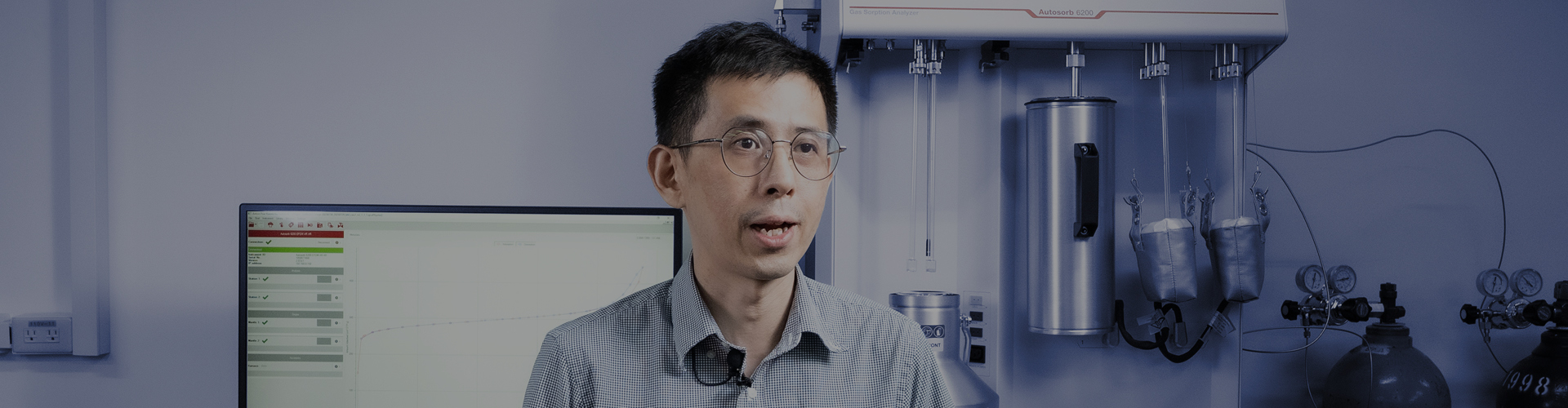

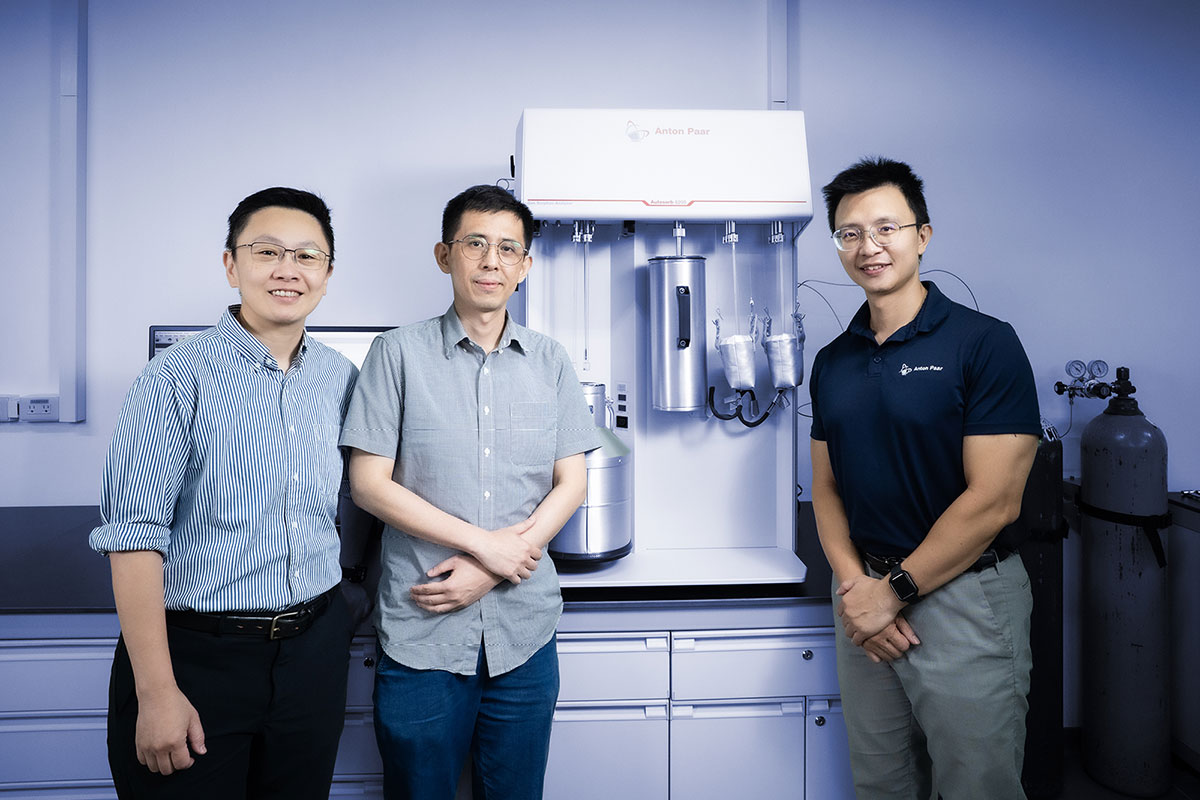
At National Taiwan University, Professor Dun-Yen Kang researches microporous materials and metal-organic frameworks for carbon capture and gas separation. With Anton Paar’s Autosorb 6200, his team measures BET surface area, active area, and pore size distribution with high precision, using nitrogen, carbon dioxide, and methane adsorption to support advanced MOF research.
MOF research for carbon capture
Professor Dun-Yen Kang from the Department of Chemical Engineering at National Taiwan University has worked in microporous materials research for more than 15 years. His current work focuses on metal-organic frameworks, or MOFs, and their application in carbon capture and gas separation.

Measuring small pores with high precision
MOF pores are typically smaller than one nanometer, so precise pore size and adsorption capacity measurements are essential. Even slight changes in organic ligands or functional groups can distort their structure, making reliable characterization critical.
Professor Kang and his team use Anton Paar’s Autosorb 6200 physisorption analyzer to measure pore size, BET surface area, active area, and pore size distribution. With P/P₀ values down to 10⁻⁷, the system reaches the very low pressure levels needed to detect extremely small pores.
More throughput and more research options
Autosorb 6200 allows simultaneous measurements on up to three ports, each reaching the same low-pressure range. It also supports gases such as carbon dioxide, methane, and nitrogen, enabling Professor Kang’s team to obtain CO₂ adsorption isotherms directly and cover multiple research needs with one system.
Expertise that keeps research moving
For Professor Kang, Autosorb 6200 offers more than measurement performance. He says Anton Paar Taiwan’s technical expertise is just as important as the technology itself, helping his team make full use of the instrument and move their MOF research forward.
"The instrument is versatile enough to meet multiple research needs with just one system."
Dun-Yen Kang - Professor at the Department of Chemical Engineering at National Taiwan University
Interested in achieving similar results?
Get in touch with our team to explore how we can support your goals and help you move your project forward.