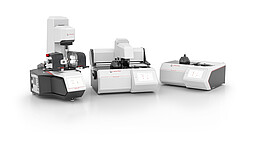
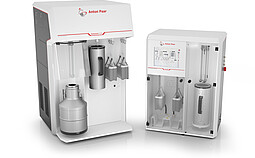
Viscometers

Benchtop

Software

  • Biodiesel viscosity measurement is established in the standards ASTM D6751 and DIN EN 14214. The viscosity is an essential parameter for the quality

    Read more ...
  • Viscometry is a classical method for characterizing polymers in solution. According to ISO 1628, viscosity measurement can also be used to

    Read more ...
  • Viscosity measurement is becoming increasingly important in breweries because it delivers useful additional information. Using the results, the

    Read more ...
  • Viscosity of Ionic Liquids, the So-Called 'Green Solvents' - Support for research and development of future liquids
  • Viscometry of polymer solutions - Styrene acrylonitrile (SAN)
  • Viscometry of polymer solutions - Rubber (Polyisoprene, Polybutadiene,…)
  • Viscometry of polymer solutions - Polyvinyl chloride (PVC)
  • Viscometry of polymer solutions - Polystyrene (PS)
  • Viscometry of polymer solutions - Polyethylene Terephthalate (PET)
  • Viscometry of polymer solutions - Polyamide (PA)
  • Viscometry of polymer solutions - General information
  • Viscometry for determining the molar mass of chitosan - Precise viscosity measurement of a natural polymer
  • Viscosity of Automotive brake fluids - Measuring viscosity for the safe performance of hydraulic systems in vehicles
  • Jet fuel viscosity - Measuring viscosity for safe landings
  • Viscometry of transformer and insulation oil - An easy and flexible solution for ‘cool’ and ‘outstanding’ stuff
  • Viscometry of heavy fuel oil and residual fuel oil - Heating the world
  • Viscometry of bunker oil, marine fuel - Driving world's economy
  • Viscometry in the Field of In-Service Oil Determination - Test in-service lube oils by determining their viscosity and VI
  • Crude oil viscosity for the petroleum industry - Characterize crude oils by determining their viscosity and API Degrees


Basics of Viscometry

Every single substance on Earth can be placed on a scale from fluid to solid. Viscometry is concerned with the determination of a fluid’s viscosity, that is its thickness or – more scientifically - its internal resistance to flowing.

External forces such as gravity affect the fluid and make it flow. Most substances change their viscosity depending on the external force. If a fluid’s viscosity remains constant independent of the external force it is called an ideal or Newtonian fluid.

One dominating influence on viscosity is temperature: the warmer it gets, the less viscous a substance becomes. Consequently, correct viscosity measurement requires precise temperature measurement and temperature control.

top


Basics of Automated Micro Viscometer AMVn

The AMVn is a microviscometer based on the rolling ball principle.

  • A ball rolls through a closed, liquid-filled capillary, which is inclined at a defined angle.
  • Two inductive sensors determine the ball's rolling time between two defined marks.
  • Both the liquid's dynamic and kinematic viscosity can be calculated from the rolling time

top


Basics of Stabinger Viscometer SVM 3000

The SVM 3000 uses the Stabinger measuring principle, named after its inventor Dr. Hans Stabinger.

  • A lightweight magnetic rotor floats in a liquid filled tube, which rotates at constant speed. The rotor is centered by the centrifugal forces.
  • The sample fluid’s viscous forces drive the rotor. This leads to an equilibrium rotor speed, which is recorded as an unambiguous measure of the fluid’s viscosity.
  • The floating rotor and a contactless measuring sensor eliminate all undesirable influence of external friction.
  • A built-in U-tube oscillator for additional density measurement permits the simultaneous determination of density, kinematic and dynamic viscosity.


top


History of Viscometry

(taken from Thomas G. Mezger “The Rheology Handbook, 2nd Edition, p. 252ff)


The word “viscosity“ is derived from the Latin word “viscum” for “mistletoe”. In the old days, mistletoe berries were used to make a sticky kind of glue for catching birds.

75 BC: Titus Lucretius Carus, poet and philosopher, writes a didactic poem on the flow and gliding behaviour of fluids like water, milk, wine, olive oil and honey.

1590: Galileo Galilei introduces the systematic use of practical scientific experiments, e.g. on liquids and solids to characterize a material’s behavior.

1649: Blaise Pascal reflects about ideal fluids without any flow resistance.

1687: Isaac S. Newton states proportionality between flow resistance and flow velocity for fluids.

Since 1800: Use of efflux viscometers (flow cups) for textile printing inks and oils.

1839: Gotthilf Heinrich Ludwig Hagen designs the first capillary viscometer.


History Automated Micro Viscometer AMVn

1845: Georges Gabriel Stokes performs scientific falling ball experiments.

1933: Fritz Höppler designs a “Falling-Ball Viscometer” (commercially available since 1934 (see also DIN 53015, and later ISO 12058).

1985: For Anton Paar KG, Dr. Jorde and Dr. Ribitsch of the Institute for Physical Chemistry at the Karl-Franzens-University of Graz develop a rolling ball viscometer with automatic angle selection, optical detection and water bath temperature control.
 
1988: Anton Paar KG introduces the AMV 200, an electronic microviscometer with inductive sensors, which also permits the measurement of opaque liquids. The inclination angle can be varied from 15° to 90°.

1999: Anton Paar GmbH presents the AMVn Automatic Microviscometer as the successor to the AMV 200. Thermoelectric temperature control (Peltier elements) replaces the water bath system.


History Stabinger Viscometer SVM 3000

2001: Anton Paar GmbH introduces the SVM 3000 Stabinger Viscometer, invented and developed by Dr. Hans Stabinger and his team at the “Labor fuer Messtechnik“ in Graz/Austria. The entirely new measuring principle is protected by the European patent EP 0 926 481 A2. Dr. Stabinger also developed the oscillating U-tube principle for precise density measurement in the 1960s.

2004: ASTM D7042-04 Standard test method for Dynamic Viscosity and Density of Liquids by Stabinger Viscometer (and the Calculation of Kinematic Viscosity)

From 2005 onwards: ASTM D7042-04 is referenced by other ASTM standards.

  • ASTM D6074 – 08 Standard Guide for Characterizing Hydrocarbon Lubricant Base Oils
  • ASTM D6823 – 08 Standard Specification for Commercial Boiler Fuels With Used Lubricating Oils
  • ASTM D6448 – 09 Standard Specification for Industrial Burner Fuels from Used Lubricating Oils
  • ASTM D7152 – 05e1 Standard Practice for Calculating Viscosity of a Blend of Petroleum Products


Contact
Contact a Sales Representative about this product
 

Media Gallery
Videos, eLearning, games and more

Enter the Gallery