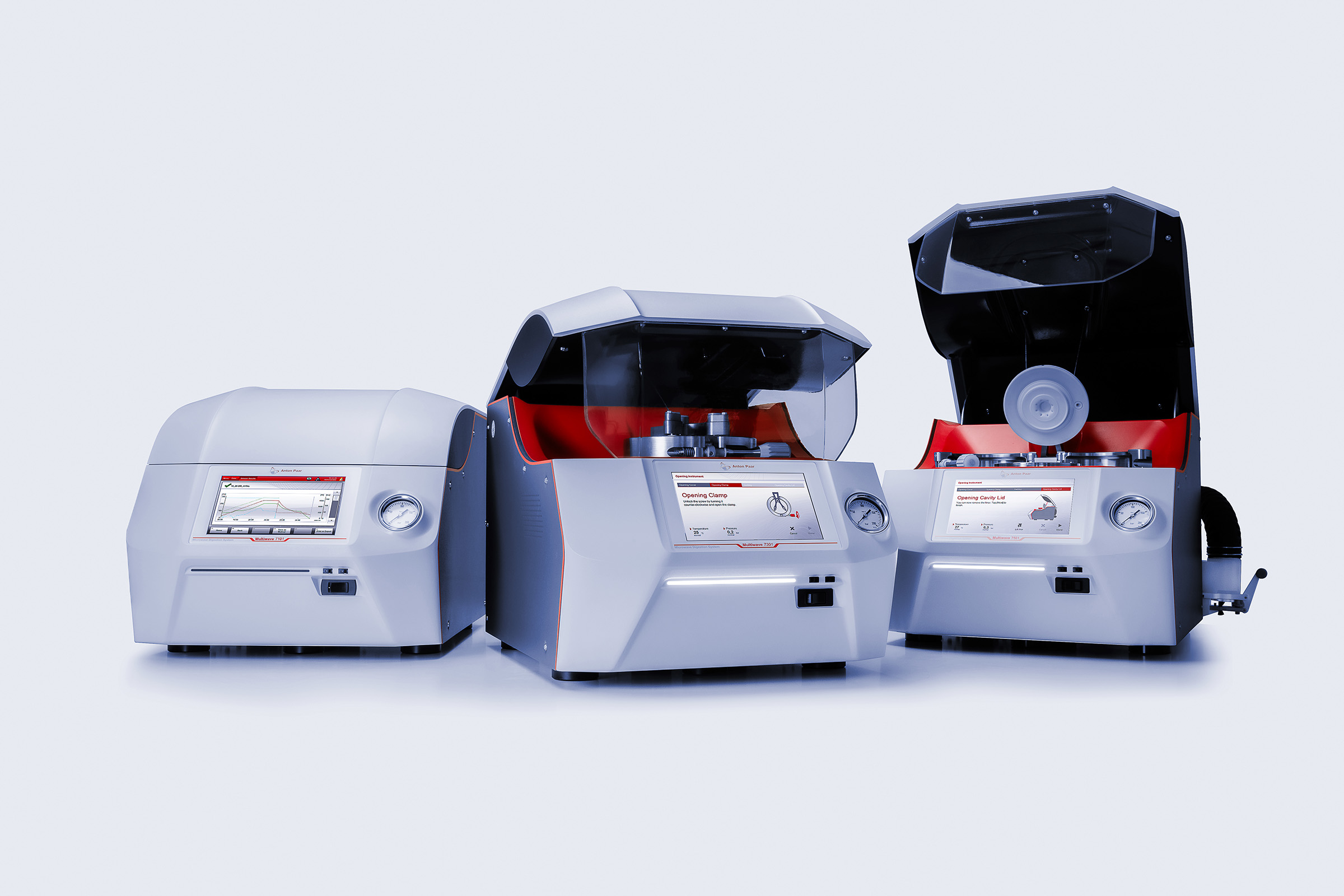
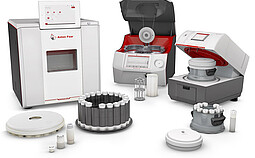
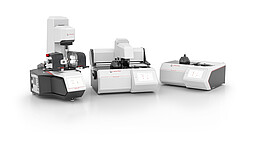
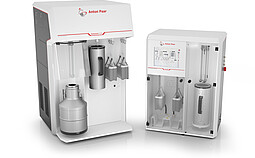
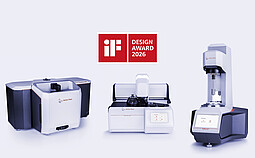
Sample preparation: Anton Paar has been working in the field of sample preparation for over three decades. Using high-quality materials and innovative solutions, Anton Paar defines a high standard. With the Multiwave PRO, Multiwave ECO and HPA-S instruments Anton Paar provides solutions for high-end applications and for the price-sensitive market.
Read more...
For sample preparation, using the reaction systems from Anton Paar, the sample is digested by heating it together with an acid mixture up to between 170 °C and 320 °C.

With the HPA-S high-pressure asher, hermetically sealed reaction vessels and pressures up to 130 bar guarantee complete mineralization of the samples.
Microwave digestion systems provide an accelerated heating phase and the possibilty of simultaneous digestion of a number of different samples. They support unique applications, such as microwave-assisted UV digestion and oxygen combustion.
The state-of-the-art sample preparation systems from Anton Paar reduce the work required for handling. They provide efficient and economic sample preparation.
The benefits speak for themselves:
Multiwave PRO
High Pressure Asher HPA-S:
Multiwave ECO:
Contact us for an in-depth discussion about our sample preparation instruments!
Sample preparation – safe, quick and efficient.
In analytical chemistry, sample preparation describes the procedures prior to analysis which are necessary to make analyte contents 'measurable'.
The analytes of interest are only in rare cases directly accessible to measurement. Very often the analytical results are distorted by matrix components or other interfering species, therefore impeding appropriate analysis. Moreover, common analytical techniques require liquid samples which contain the analytes in a dissolved form. For this reason, sample preparation is required in order to transfer a sample into a measurable form.
Depending on the analytes of interest and the requirements of the subsequent analysis one of the following sample preparation techniques can be applied:
Conventional open digestion methods (e.g. hot plate, hot block) have several advantages as they are easy to handle and have low investment costs - basically due to the absence of sophisticated technologies.
Nevertheless, they also suffer from severe drawbacks, such as high reagent consumption, risk of contamination, risk of analyte losses and long digestion time due to the limited temperature.
In a closed system the reaction temperature can exceed the boiling point of the reaction mixture. Therefore, the temperature will be limited by the pressure and/or temperature limit of the used vessel type only. As a consequence, even lower boiling reagents can be used at higher temperature in a closed vessel system.
Closed vessel digestion has following advantages:
Anton Paar offers two sorts of instruments for closed-vessel sample preparation:
HPA-S is the reference instrument for chemical sample preparation!
The name "High Pressure Asher" refers to "wet chemical ashing", which is another term for "acid digestion".
The working principle of HPA S is simple and efficient.
Reaction vessels (quartz, or glassy carbon) filled with sample and digestion reagents are sealed with a PTFE strip and a quartz lid and placed inside a conventionally heated heating block.
The heating block is positioned inside a stainless steel autoclave, which is then filled with 100 bar of gaseous nitrogen. The surrounding nitrogen pressure hermetically closes the reaction vessel.
The autoclave is heated up according to a pre-programmed, sample-specific temperature program.
During heating, pressure inside the reaction vessel is built up, but the reaction vessel stays tight as long as the internal pressure is lower than the surrounding pressure of approx. 130 bar..
After the run the instrument cools down automatically and nitrogen is released from the autoclave. Once the autoclave is at normal pressure, the lid can be opened and the reaction vessels can be removed.
Specifications
Continuous operating temperatures up to 320 °C and unlimited decomposition time ensure the highest possible digestion quality.
Heating with microwaves (electromagnetic waves in the range of 300 MHz (0.3 GHz) to 3 000 GHz) is based on two mechanisms:
In contrast to conventional heating, microwave heating directly heats the liquid bulk, while the surroundings (like vessels) remain comparably cool. As a consequence, microwave heating is fast and energy-efficient. As a further benefit, cooling can be more efficient, as primarily only the liquid bulk has to be cooled down.
Anton Paar offers two microwave-heated systems for sample preparation: Multiwave ECO, Multiwave PRO.
The easy-to-use and budget-friendly Multiwave ECO microwave digestion system focuses on acid digestion and leaching of routine samples working with only three rotors:
Rotor 16HVT50 is a brand-new design with vessel support tubes made of fluoropolymer-coated aluminum and 16 pressure-activated-venting vessels.
Multiwave PRO is a high-end microwave reaction system.
Combining the benefits of a closed-vessel system with rapid microwave heating Multiwave PRO is a highly modular and therefore very versatile system which can cope with almost any sample preparation task:
Since 1972 Cooperation with Prof. Günter Knapp, Graz University of Technology,
Graz, Austria
1975 VAO automatic wet digestion system
1978 “Trace-O-Mat“ oxygen combustion device
1983 HPA High Pressure Asher
1984 CPA-1 Cool Plasma Asher
1988 CPA-4 Cool Plasma Asher
1989 PMD microwave digestion system
1993 Installation of Anton Paar’s own application laboratory
1995 HPA-S, the new High Pressure Asher
1996 MULTIWAVE microwave system
1998 Extending the MULTIWAVE platform:
stirring, drying and evaporation accessories
2001 Multiwave 3000 with Rotor 16
Expansion of the application lab and support capacity
2002 Multiwave 3000: Rotor 8S, evaporation & drying rotors
2003 Microwave-assisted solvent extraction
2004 Microwave-induced oxygen combustion
2005 High throughput microwave digestion solutions
2006 Microwave-assisted hydrolysis
2010 Microwave decomposition of microsample
2012 Microwave reaction system: Multiwave PRO with Rotor 8N
Microwave digestion system: Multiwave ECO with Rotor 16HVT50